School mobility
One campus. All mobility. One system.
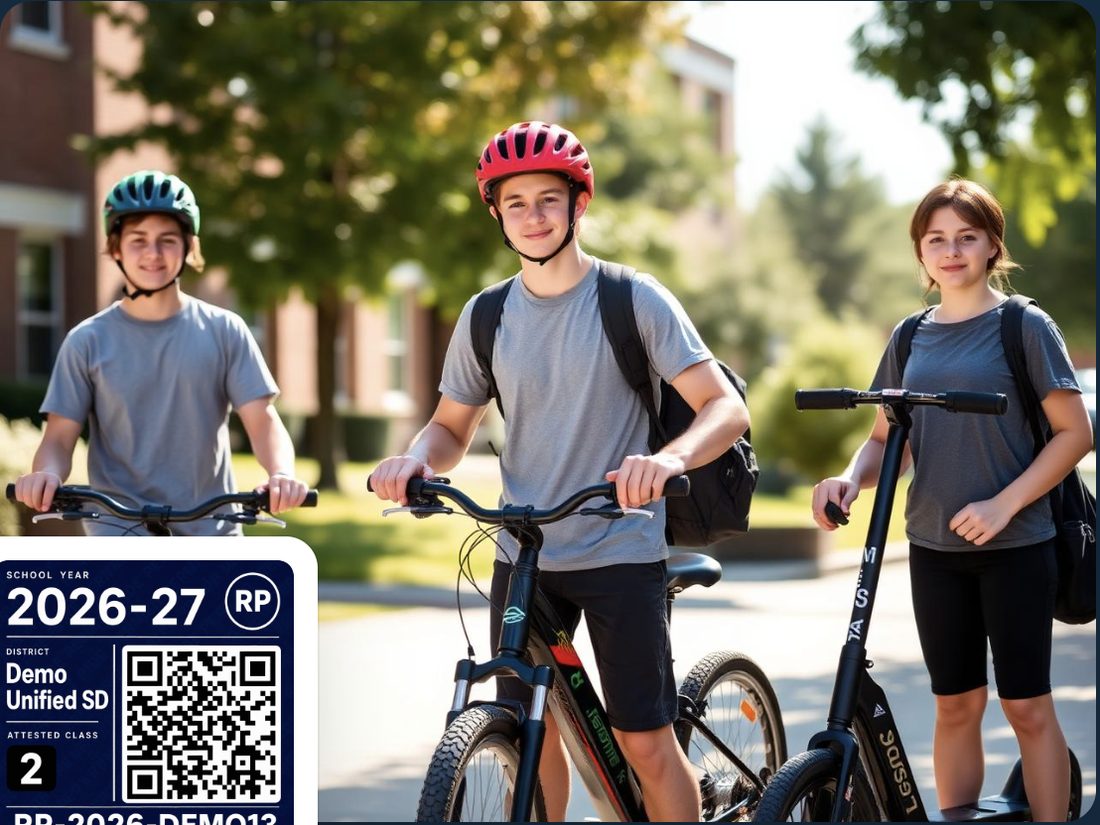
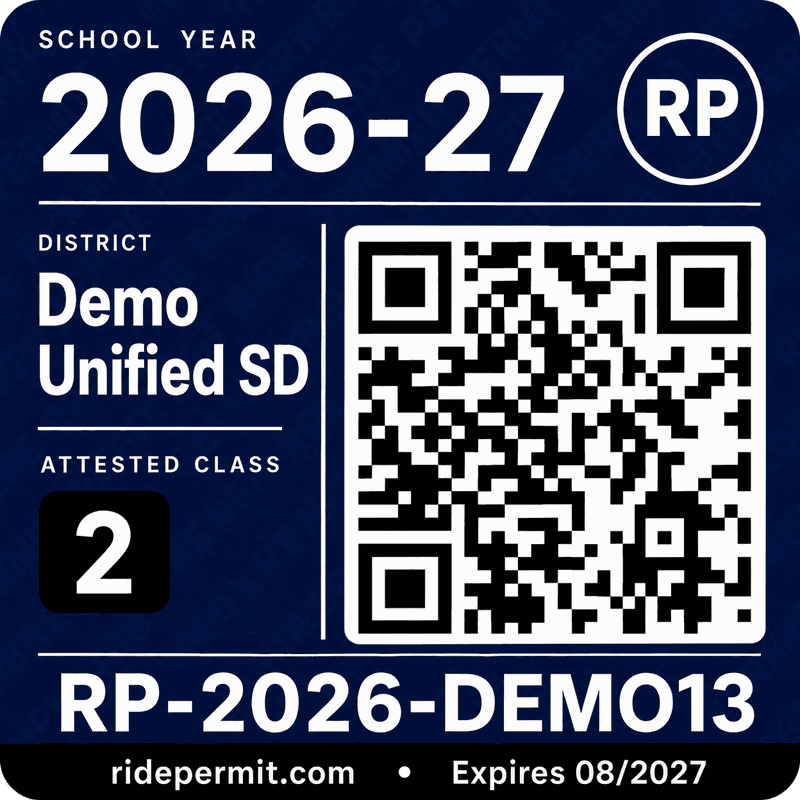
Students roll onto campus on all kinds of wheels. RidePermit gives a school one place to register them, one permit per ride, and one way for staff to verify it in seconds.
Choose your vehicle type
Every ride fits one of two lanes.
E-bikes, and everything that isn't an e-bike. The requirements are different because the risks are different.
E-bike permits
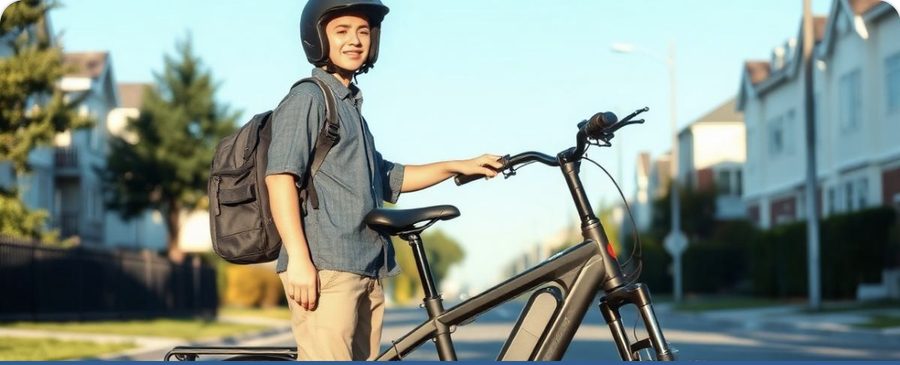
Class 1, 2, and 3. Riders complete the safety course their district requires, then receive a scannable permit tied to the bike and the student.
- Legality checked against state law and district policy
- Four-module safety course, tested per module
- Serial number and bike photo on file
- Parent contact request from a scan, where opted in
- Stolen-bike recovery support
Includes e-bike safety training and certification.

Everything that isn't an e-bike
Bikes, scooters, e-scooters, skateboards, one-wheels, hoverboards, and anything else with wheels that ends up on the rack.
- Digital permit and decal
- Registered to the student and the device
- Short safety check matched to the device
- Scannable by campus staff
- Identifiable if it goes missing
Lighter requirements, same permit and decal.
Registration process
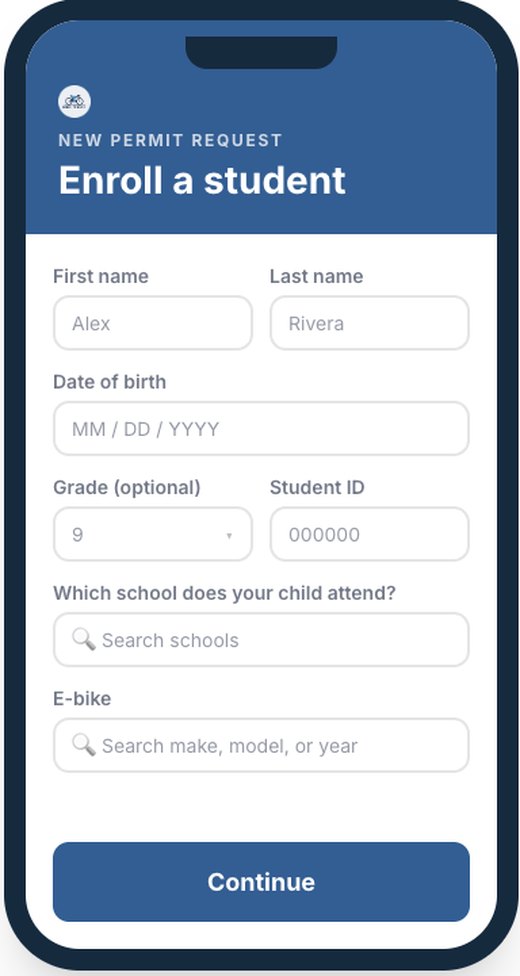
Same account, same student, same decal.
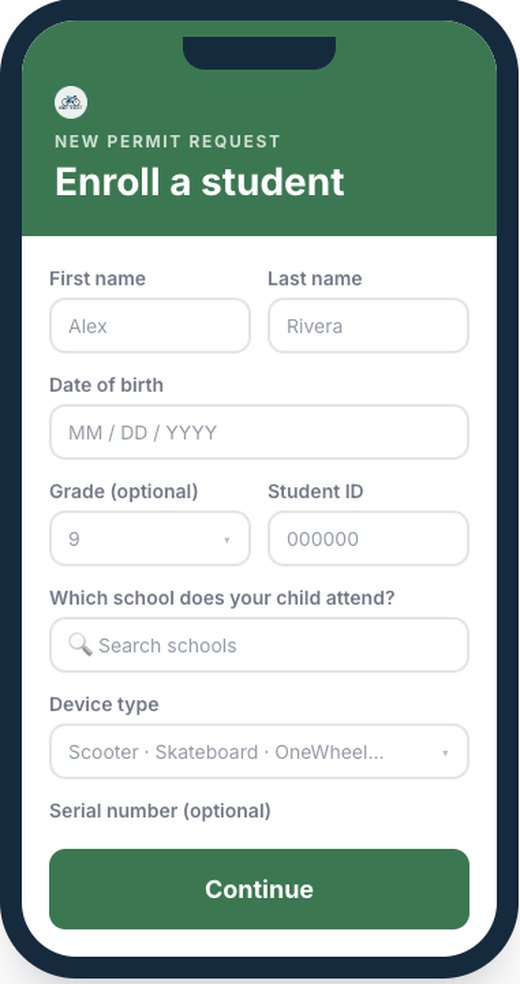
The e-bike lane adds the bike legality check and the full safety course. Everything else gets a shorter safety check matched to the device.
E-bike
Everything that isn't an e-bike
The one that matters most
Catching the e-moto before it reaches the rack.
The devices causing the worst injuries are often not e-bikes at all. They are sold next to e-bikes, look like e-bikes, and are legally motorcycles.
What "out of class" means
Every state defines an e-bike with a motor cap, a speed cap, and a throttle rule. A device that exceeds any of them is not an e-bike, usually cannot be ridden without a license, and has no business on a school campus.
- Motor over the state's cap, commonly 750 watts
- Assisted speed over 28 mph
- Throttle above 20 mph
- Sold as "off-road only" with lights and a kickstand
- Caught at registration, not at the gate. The make and model is checked against the catalogue. An out-of-class vehicle never gets a permit, and the parent is told why in plain language.
- Switchable bikes are flagged. Many popular models ship as Class 2 and unlock to Class 3 in an app. Registration shows both configurations and which one the district allows.
- Staff never have to argue about it. The verdict comes from state law and district policy, cited, not from a campus supervisor's judgement at 7:45 in the morning.
Built for the whole campus
E-bikes are less than half of what's on the rack.
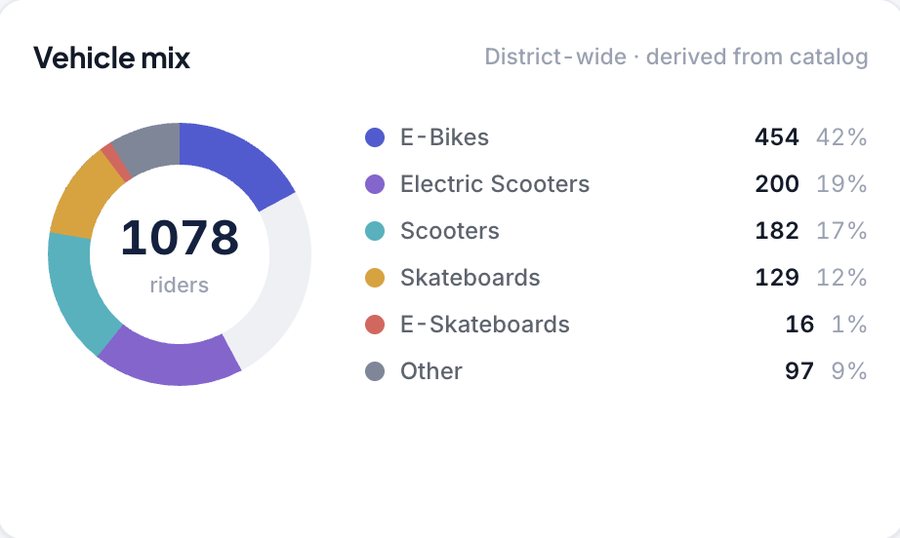
A district that only permits e-bikes still has the rest of the rack to manage. One program covers it, one dashboard reports on it, and a family with an e-bike, a scooter, and a skateboard fills in one account.
Questions
About devices other than e-bikes.
Do we have to register scooters and skateboards, or just e-bikes?
The district's choice. Most start with e-bikes and add scooters within the first year, once they see how much of the rack was unaccounted for. Every device type can be switched on or off in policy settings.
Does a scooter rider take the same course as an e-bike rider?
No. Non-e-bike riders get a short safety check matched to the device rather than the full four-module course. Districts can require more.
How do you know a device is out of class?
The make and model is checked against a catalogue of manufacturer specifications. If the motor, top speed, or throttle exceeds the state's e-bike definition, registration fails and the parent is shown why. Devices not in the catalogue can be entered by spec and reviewed by staff.
What about a bike that has been modified?
The parent declares the class at registration and affirms it is accurate, and the permit says so. RidePermit does not inspect bikes, and does not claim to.
Does the price change if we add device types?
No. The subscription is banded on permitted devices, whatever they are. Adding scooters does not change the price until the total count crosses into the next band, and then only at renewal.
Bring your current rules for the rack.
We will configure every device type you allow into a live portal and walk your team through it in about thirty minutes.